
Sasha Alexander, volunteer, and Linda LaVallie, Rachel’s Hope executive director.
By Jenny Qi
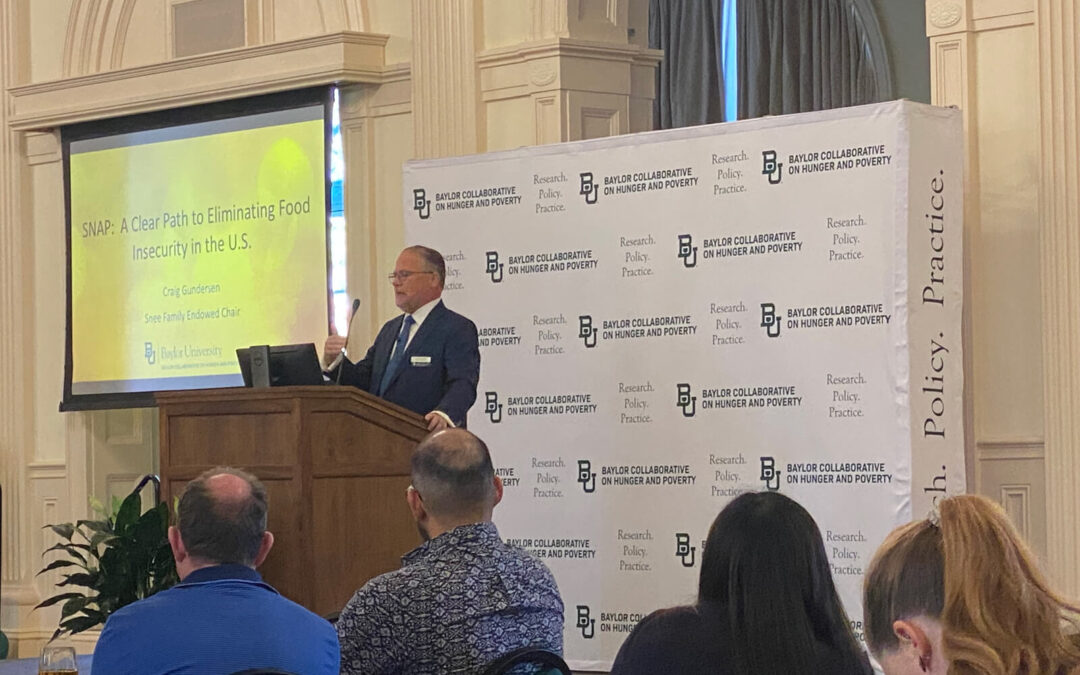
Food insecurity 101 with economist Craig Gundersen
In a nation that produces such a remarkable abundance of food, one might wonder whether and how anyone goes hungry here. This turns out to be a much more complicated question than it sounds. Even defining “hunger” and “food insecurity” is a challenge. What does it mean to go hungry?
“Hunger” is an imprecise term. Dr. Craig Gundersen, who is the Snee Family Endowed Chair at the Baylor Collaborative on Hunger and Poverty and teaches economics at Baylor University, gave an example: “We’re hungry every day, and then we eat to alleviate our hunger.” In this case, hunger is an individual, and often fleeting, physiological condition: signals from our brains that we require food, one of the most basic human needs according to Maslow’s hierarchy of needs.
But when nonprofits like Feeding America talk about alleviating hunger, they mean something much more specific. As Gundersen said, “We have an idea of what hunger entails — being hungry, but not able to eat food to alleviate that hunger.” Because of the imprecision of the word “hunger,” Gundersen and other researchers use the term “food insecurity” which broadens the concept. Only individuals get hungry, but families and communities can be food insecure.
What is food (in)security?
While many organizations continue to use “hunger” and “food insecurity” interchangeably, precise language is needed to measure and address food insecurity. Because of this, food insecurity is now defined in a very specific way by the U.S. Department of Agriculture (USDA), based on recommendations by a panel of experts in the field. There are four defined ranges of food (in)security:
Food Security
- High food security (old label = Food security): no reported indications of food-access problems or limitations.
- Marginal food security (old label = Food security): one or two reported indications—typically of anxiety over food sufficiency or shortage of food in the house. Little or no indication of changes in diets or food intake.
Food Insecurity
- Low food security (old label = Food insecurity without hunger): reports of reduced quality, variety, or desirability of diet. Little or no indication of reduced food intake.
- Very low food security (old label = Food insecurity with hunger): reports of multiple indications of disrupted eating patterns and reduced food intake.
Notably, according to the USDA’s formal definitions, food insecurity can exist without someone being chronically “hungry.” For example, if someone doesn’t have the resources to prepare nutritionally balanced and varied meals, but they are always able to meet their daily caloric requirements through low-cost staples such as white bread and peanut butter, they might be experiencing “low food security” as defined by the USDA. Someone with low food security is not actively starving, but they may need to make sacrifices for that to be true.
Food insecurity is measured by 18 questions called the Core Food Security Module. According to Gundersen, someone who has responded affirmatively to three or more questions meets the criteria for food insecurity, and about 1 in 9 people in the U.S. is food insecure by this metric. From 2010 to 2021, these numbers declined by 35%, but food insecurity has once again risen with inflation and the higher cost of food.
In 2009, updates were made to the definition of food security determined at the 1996 World Food Summit: “Food security exists when all people, at all times, have physical, social and economic access to sufficient, safe and nutritious food to meet their dietary needs and food preferences for an active and healthy life.” To return to Maslow’s hierarchy, there are many steps between avoiding starvation and living a fulfilled, “active and healthy life.” The concept of food security is intended to address these in-between steps.
Misconceptions about food insecurity
There are a number of common misconceptions about what food insecurity is and what its causes and consequences are, perhaps in part because people have not always been aligned on how to discuss it. Here are some of the top misconceptions, according to economist Craig Gundersen:
Food insecurity is a poverty issue. Poverty is associated with food insecurity, and low wages and unemployment impact people’s purchasing power. But it’s not the whole story, according to Gundersen. “70% of poor people are food secure, and roughly 10-15% of non-poor people are food insecure. If tomorrow, we’re able to eliminate poverty in the United States, it would make a dent in food insecurity, but not nearly as much as people think.”
Food prices.
On the flip side, inflation has a very direct correlation with food insecurity (Rachidi and Gundersen, 2024). This can impact even higher-earners who haven’t budgeted for a spike in food prices. “Why did food insecurity rates increase from 2019 to 2022? Almost completely explained by increases in food prices,” Gundersen said.
Determinants of food insecurity.
“By far, the biggest predictor of food insecurity in the United States is disability status.” This includes mental illness, which afflicts a fifth of adults in the U.S. “We have a mental health crisis, which feeds into a food security crisis.”
Things that don’t cause food insecurity.
“People talk about food deserts all the time, but there’s no connection,” Gundersen said. People who do not live near grocery stores may need to drive farther to purchase nutritious foods, but it does not necessarily mean they are food insecure.
What helps alleviate food insecurity.
Gundersen is an expert on and advocate for the Supplemental Nutrition Assistance Program (SNAP), formerly called the Food Stamp Program. His research shows that SNAP is “extraordinarily successful in alleviating food insecurity. After controlling for non-random selection into the program, SNAP recipients are 15—30% less likely to be food insecure in comparison to eligible non-participants.” Because food insecurity is related to higher healthcare costs, alleviating food insecurity might also benefit the healthcare system.
Impacted by a number of socioeconomic factors as well as conflict and climate change, food security is a complex, multifaceted problem within the larger food system. Because of this, linguistic precision is important for addressing the various aspects of food insecurity.
“In many cases, a ‘food security’ organization’s focus may be more appropriately described by terms such as ‘nutrition security,’ ‘hidden hunger,’ ‘food insufficiency,’ ‘food access,’ ‘food capacity,’ ‘food resilience,’ ‘food rights,’ or ‘food sovereignty’” (Guine and Varzakas, 2023). For example, an organization focused on increasing the nutrient density of school lunches might be more accurately described as focusing on nutritional security. Food sovereignty is defined by the U.S. Food Sovereignty Alliance as the right of people to access “healthy and culturally appropriate food produced through ecologically sound and sustainable methods, and their right to define their own food and agriculture systems.” These are all important concepts in the food system and may be related to food insecurity, but they are not precisely the same.
Food, Language, and Meaning Across Cultures
The fundamental importance of food security to human survival is reflected in and even shaped by the language we use to describe food.
In English, one might say, “I’m so hungry I could eat a horse,” a hyperbolic expression of acute hunger with possible origins in 17th century England. Horse meat was not only unpalatable because of its reputed toughness, but also horses were valuable, so their loss was not taken lightly. Horses, critical for many families’ livelihoods, were often seen as part of the family. During the Napoleonic wars, calvary soldiers resorted to eating their horses when their lives depended on it, but it was an act of existential desperation. Thus, to be hungry enough to eat a horse meant one was in truly dire straits.
In Chinese, to eat a meal (吃饭) literally translates to “eat rice,” reflecting the importance of this staple grain. China also has the concept of the “iron rice bowl,” or a career that guarantees job security, such as that of a civil servant or even a physician. To have a stable job is to be able to eat, the phrase implies, underlining the importance of food security for a country with a history of famines. During the Great Chinese Famine of 1959-61, an estimated 17-45 million people in China died from starvation.
In Egypt, the word for bread is “eish” (عيش), which is also Arabic for “life.” Baladi bread is a key staple of the Egyptian diet. As a result of violent protests against the rising costs of food during World War II, the Egyptian government decided to start subsidizing bread for its citizens. Despite multiple revisions over time and repeated attempts to revisit the subsidies, widely considered to be economically unsustainable for the Egyptian government, bread subsidies have remained in place since 1941.
Appendix
Core Questions from the
U.S. Household Food Security Survey Module
|
1. “We worried whether our food would run out before we got money to buy more.” Was that often, sometimes, or never true for you in the last 12 months? |
|
2. “The food that we bought just didn’t last and we didn’t have money to get more.” Was that often, sometimes, or never true for you in the last 12 months? |
|
3. “We couldn’t afford to eat balanced meals.” Was that often, sometimes, or never true for you in the last 12 months? |
|
4. “We relied on only a few kinds of low-cost food to feed our children because we were running out of money to buy food.” Was that often, sometimes, or never true for you in the last 12 months? |
|
5. In the last 12 months, did you or other adults in the household ever cut the size of your meals or skip meals because there wasn’t enough money for food? (Yes/No) |
|
6. “We couldn’t feed our children a balanced meal, because we couldn’t afford that.” Was that often, sometimes, or never true for you in the last 12 months? |
|
7. In the last 12 months, did you ever eat less than you felt you should because there wasn’t enough money for food? (Yes/No) |
|
8. (If yes to Question 5) How often did this happen—almost every month, some months but not every month, or in only 1 or 2 months? |
|
9. “The children were not eating enough because we just couldn’t afford enough food.” Was that often, sometimes, or never true for you in the last 12 months? |
|
10. In the last 12 months, were you ever hungry, but didn’t eat, because you couldn’t afford enough food? (Yes/No) |
|
11. In the last 12 months, did you lose weight because you didn’t have enough money for food? (Yes/No) |
|
12. In the last 12 months, did you ever cut the size of any of the children’s meals because there wasn’t enough money for food? (Yes/No) |
|
13. In the last 12 months did you or other adults in your household ever not eat for a whole day because there wasn’t enough money for food? (Yes/No) |
|
14. In the last 12 months, were the children ever hungry but you just couldn’t afford more food? (Yes/No) |
|
15. (If yes to Question 13) How often did this happen—almost every month, some months but not every month, or in only 1 or 2 months? |
|
16. In the last 12 months, did any of the children ever skip a meal because there wasn’t enough money for food? (Yes/No) |
|
17. (If yes to Question 16) How often did this happen—almost every month, some months but not every month, or in only 1 or 2 months? |
|
18. In the last 12 months did any of the children ever not eat for a whole day because there wasn’t enough money for food? (Yes/No) |
Additional references:
- Food waste statistics: https://www.feedingamerica.org/our-work/reduce-food-waste
- Obesity statistic: https://www.cdc.gov/obesity/data/adult.html
- Mental illness statistic: https://mhanational.org/issues/2022/mental-health-america-adult-data

Hometown Food Security Project
318 Main St N.
Austin, MN 55912
Get Involved!
If you’d like to volunteer with these efforts, let us know on this form.