
By Alba Muñoz Saiz
This internship program brought new energy and new ideas to the fight against hunger in Mower County
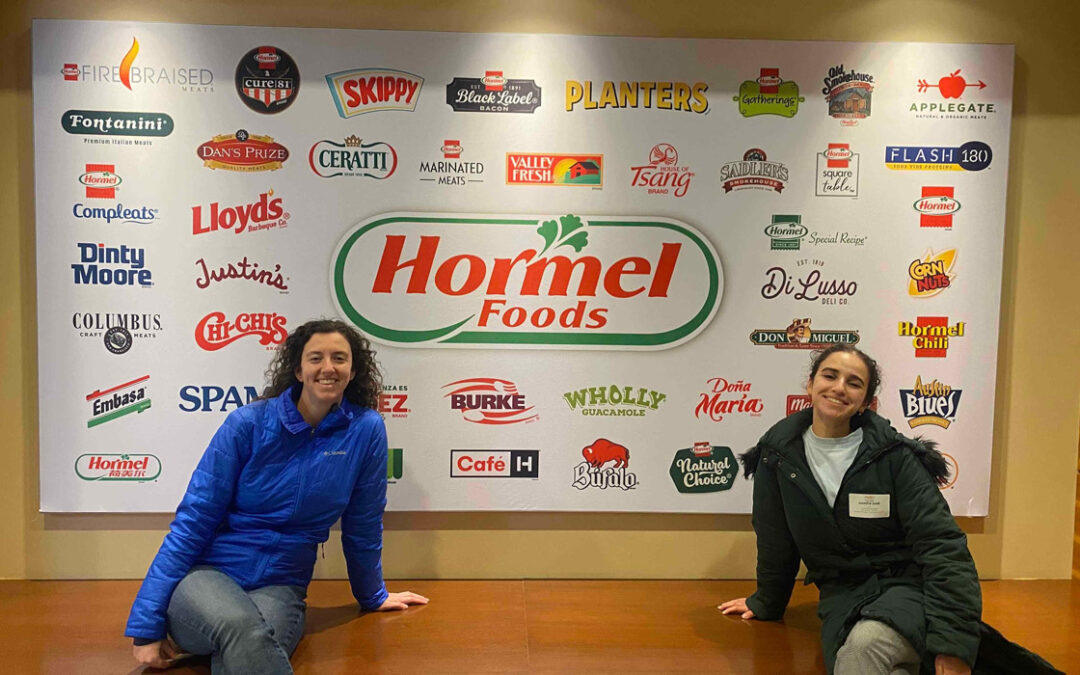
Future doctors, pharmacists and other healthcare professionals are more regularly being taught to look beyond the exam room, to consider how housing, income and especially food access shape a person’s health. This connection became tangible for University of Minnesota students Martha DeMeules and Jasmine Zaidi during a year-long internship in Austin, Minnesota. As part of the Hometown Food Security Project, the pair worked alongside local partners to understand the barriers families face, and identify ways to make healthy food more accessible across the community.
The internship builds on work started by previous student cohorts and continues an ongoing collaboration between the University of Minnesota and local organizations, including Hormel Foods, Mayo Clinic Health System, Austin Public Schools and United Way of Mower County. Each intern team brings new energy, expertise and perspective to this deeply collaborative effort.
Turning Insight into Action
Among the opportunities to take action, Martha and Jasmine decided to focus part of their internship on a project they felt could benefit from both structure and support. “We decided that we’re going to primarily focus on helping with the redesign of the Austin High School food pantry,” Martha explained. “They’ve had it in place for a while now, but they’re incorporating it into a class, where students will help organize and manage it.”
The goal was to create recommendations to support the pantry’s day-to-day operations while making it easier for future student leaders to manage it. Their ideas included creating a consistent inventory tracking system and exploring ways to improve accessibility — such as a pilot for online ordering.
One barrier they identified was stigma, especially for students who might be uncomfortable being seen taking food. “We tried to think of ideas that would reduce that,” Martha said. “There’s already an ordering system that’s being piloted — so you could just go and pick it up and not have to be in the space where everyone’s watching you.”
Jasmine emphasized that their role was about making the system more approachable for everyone. “We were just trying to make it accessible, but also not intimidating,” she said. “To make it something that’s inviting.”
Collaboration on the Ground
While the students brought academic training in medicine and pharmacy, they were quick to highlight the importance of listening to community members. From their first site visit to stakeholder meetings with groups like Hormel Foods and United Way, they spent much of the internship gathering feedback and learning from those already doing the work.
“There’s a lot of passion for reducing food insecurity in Mower County,” Jasmine said. “It was really impressive to see how the stakeholders were reaching out — asking for feedback, looking for ideas. That’s not always the case in community projects.”
One particularly striking insight came from conversations with community health workers (CHWs), who shared that while they play a trusted role in immigrant communities, they’re often underutilized.
Martha and Jasmine noted that CHWs could be powerful partners in SNAP education and outreach, especially if given tools to tailor information for different cultural and linguistic groups. But recent shifts in national policies have decreased program engagement. As a result, CHWs are focusing much of their energy on building trust and providing reassurance.
The Health Connections
As future healthcare professionals, Martha and Jasmine saw their internship as a chance to connect the dots between what they learn in the classroom and what people experience in their daily lives. For both students, the link between food and health wasn’t just theoretical — it was central to their understanding of how to care for people more effectively.
“We’re often talking about the social determinants of health,” Martha said. “Things like your zip code being a greater determinant of health than your genetics. Food is definitely one of them.”
In pharmacy school, Jasmine noted, the focus is often on medication, but nutrition plays a vital role that can’t be overlooked. “People assume we only learn about drugs, but the first-line intervention for so many chronic diseases is diet and lifestyle,” she said. “If someone’s food insecure, they’re missing that opportunity completely. It really impacts how we treat people.”
They also reflected on how food access deeply affects day-to-day life: how hunger makes it hard for kids to focus at school, and how poor diets lead to long-term health issues that disproportionately affect low-income families. “It’s just this domino effect,” Martha said.
Improving Systems
During their program, Martha and Jasmine discovered how much work was already in motion to strengthen the local food system, not just in pantries and classrooms, but across healthcare and human services. Leaders like Kris Johnson, administrator of population health and value-based contacts at Mayo Clinic Health System, are helping to advance that work by fostering stronger collaboration between providers, social workers and CHWs. These efforts aim to make the system more connected, coordinated and easier for families to navigate.
It’s just one example of how the internship intersects with broader progress happening across the Hometown Food Security Project. For internship students, it’s an opportunity to learn through real-world engagement. For local partners, it’s a chance to explore new ideas and enhance impact.
As their internship wrapped up, Martha and Jasmine helped move the work forward with fresh perspective and practical ideas. Their findings highlighted the importance of trust and tailored outreach, and surfaced small, actionable changes that could make food access more inclusive for all.

Hometown Food Security Project
318 Main St N.
Austin, MN 55912
Get Involved!
If you’d like to volunteer with these efforts, let us know on this form.